
Sometimes We Measure Love in Gold


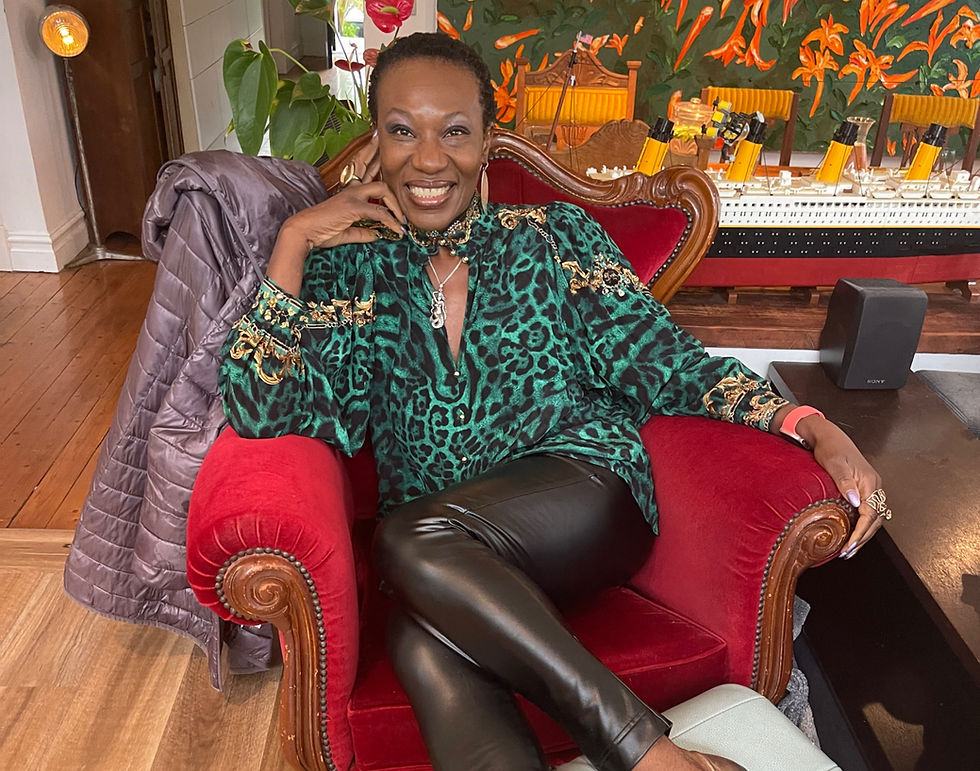
At my mother's funeral. In our tribe's tradition, the immediate family wear white to funerals |
I'm writing this from London, where I buried my mother on Monday.
I want to begin with the part I'm least proud of — because I've come to believe that's exactly where the wisdom was waiting for me. This month, we're sitting with healing and trauma, and it felt only right that I share my own. As a therapist, I am a holder of other people's secrets. Their deepest pain, the things they've never said aloud. To be trusted with that is an honour. But we who hold so much rarely set out to expose our own. So I'll confess it plainly: I am a self-professed over-sharer. It's how I keep the scales honest. If I'm going to ask you to be brave in your own healing, I have no business hiding in mine. So I promise to be open and honest with you in this space.
Here is the truth I've carried for most of my life: the quiet, persistent belief that I was the forgotten one. The lost child. The least loved.
I know exactly where that belief was born.
When I was one year old, my parents and my brother left Nigeria to build a new life abroad — and I was left behind. I was too small to understand it, too small to remember the leaving. But my body remembered. A child that age doesn't have words for they went and I stayed; it only has the feeling. And the feeling settles in the bones and calls itself truth: you are the one who gets left.
I was reunited with my family in time. But something in me had already learned its lesson too well. I grew up scanning every room, every relationship, for the evidence I was sure would come — the proof that I was, once again, the one who could be set aside. I learned to measure love in things I could hold and count, because a feeling had once betrayed me and I no longer trusted feelings alone. That single early wound quietly warped the way I read the whole world: I could receive love, but only in the language I'd already decided counted. Anything else, I overlooked. Or worse, I read it as rejection.
I tell you this so you'll understand what happened next.
Grief, I'm learning, doesn't only bring sorrow. It hands you a magnifying glass and invites you to go looking for old evidence. So I went looking.
Some years ago, my mother had left me a beautiful matching set of gold jewellery in her will. Then she changed her mind. The gold went to my niece, and to me she left a set of traditional Nigerian coral beads. I was devastated. I read it exactly the way that one-year-old had taught me to read everything: as a demotion. As proof of the very thing I had always feared.
And as executor of her will, I am embarrassed to admit, I began to plot. I told myself I might gather my sister and my niece and, as the eldest, quietly redistribute the gold so that I could choose "my" pieces first. I convinced myself this was only fair. That quietly manipulating the people I love was somehow the just thing to do.
That is the truth of where I was. Bargaining with grief in the small, ungenerous hours.
Then I learned what the coral actually means.
In our tradition, coral beads are not a lesser gift. They are royalty. In Nigerian culture, coral is the regalia of kings and chiefs, worn at coronations, at weddings, and at the most sacred moments of a life. It is not measured in money. It is the heritage piece: passed down to the lineage holder, entrusted to the one chosen to carry the family forward.
My mother had not demoted me. She had named me.
She made me executor of her wishes and keeper of the coral — the one who carries the line. The gold was beautiful, but the gold was only gold. The coral meant ancestry. Trust. Continuity. And I had almost missed it entirely, because I was so busy guarding a fifty-year-old wound that I could only recognise love in the one language I'd long ago decided was the only one that mattered.
On Monday, our community and our family gathered to lay her to rest. What struck me was not the warmth shown to me, though there was so much of it. It was how much was now being placed in my hands. Decisions were turned over to me. The elders came and sat with me. Offers and donations were brought to me. And I understood, quietly, that this was the coral again, in another form — not a tribute to be enjoyed, but a responsibility to be carried.
The morning of the burial, I meditated and asked my mother to guide every word and every move I made that day. I did not feel grand. I felt held, a little daunted, and aware that I was stepping into something far larger than myself. I can only hope to carry it with the dignity and the humility she carried it with.
I am so grateful I did not have that conversation with my sister from that wounded place. Grateful that I came to see, in time, that I was not being loved less. I was being entrusted with more.
As I step into this new season as the matriarch of my family, that is the lesson I am carrying with me, and the one I want to offer you:
Sometimes we measure love in gold, when all along we are being handed coral.
With love, Faith |


Comments